Rare Earth Indeed
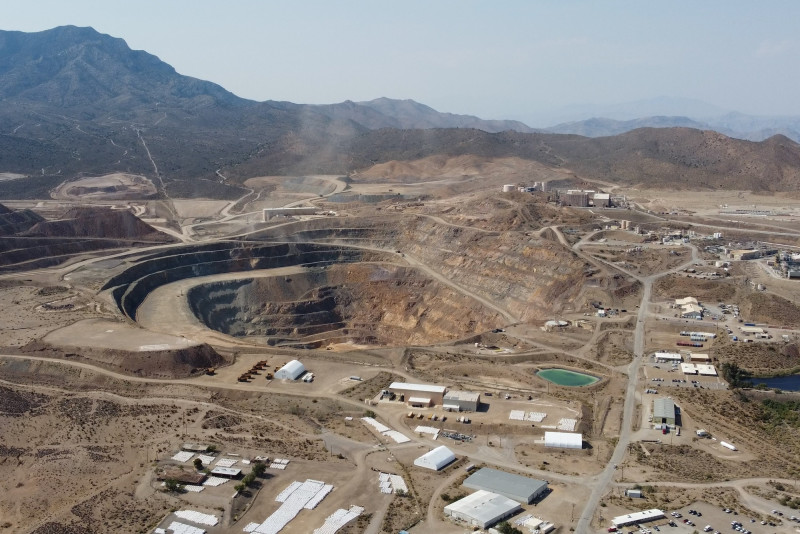
WITH ALL THE TALK ABOUT the geopolitics and hyper-criticality of rare earths, its important to remember that the pit that started it all has been there all along, riding the waves of the global marketplace, next to the interstate, for all to see coming and going between Las Vegas and Los Angeles.
The Mountain Pass Mine opened in the 1950s, and grew rapidly in the 1960s, when rare earths enriched the colors in cathode ray tubes, and the mine became known as the hole in the ground dug by color television. Through the 1970s and 1980s, Mountain Pass continued to be the nation’s only rare earth mine, supplying most of the world’s rare earths, still used in color TVs, but also in magnets enhanced by rare earth elements, used in products like speakers, microphones, guitar pickups, and model train motors. Rare earths were rapidly finding their way into all sorts of commercial, high-tech, and critical applications as well.
By the 1990s, China had scaled up production, especially at the Bayan Obo mine and processing complex in Mongolia, which became the largest single source of rare earths in the world. China also helped develop other sources, including mines in Myanmar. By the late 1990s, China’s production had reduced prices enough that the Mountain Pass mine became too expensive to run. With mounting pressure from the state to address toxic waste problems too, most operations ceased in 1998.
The contamination problem was due to leaks and toxic accumulations along the liquid waste pipeline which ran from the mine, at the pass, to evaporation ponds in the middle of Ivanpah Dry Lake, 15 miles away in the valley below. Contamination included naturally-occurring radioactivity from minerals at the site becoming concentrated enough to pose a risk to the environment.
After paying fines and cleaning most of it up, the mine was allowed to start up again in 2004, though it did so in a limited way. In 2008, the Chevron oil company, its owner at the time, created an independent company, Molycorp, to modernize and upgrade the operation further, to make it competitive with the current global marketplace. With close to a billion dollars of support from the Department of Defense, to address contamination issues and expand processing capability, the mine opened again, in 2013. Despite the support, with China controlling close to 100% of global rare earth processing, it was unable to compete, and Molycorp filed for bankruptcy in 2015.
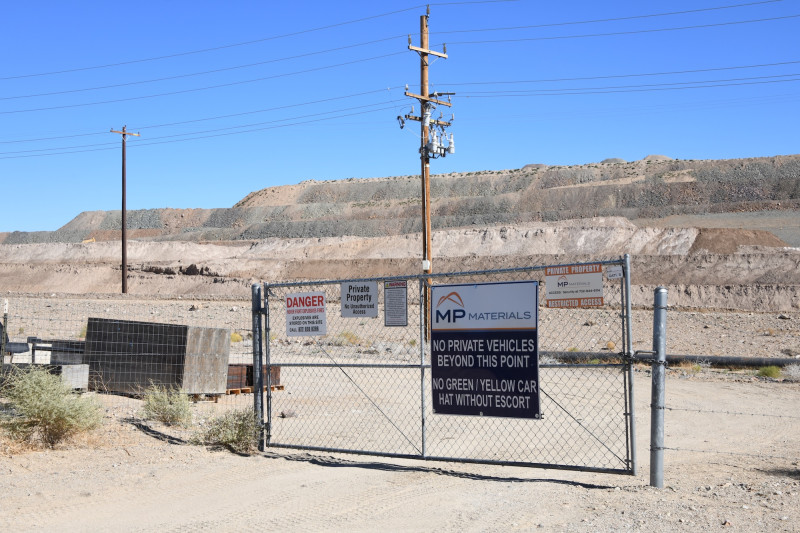
In 2017, while in “care and maintenance” status, with just eight employees, a new company, MP Materials, was formed to purchase and reboot the mine. MP Materials started limited production in 2018, focusing on neodymium and praseodymium, rare earth elements used to make high powered magnets used in electronics and motors.
In July, 2025, the Department of Defense bought $400 million worth of shares in MP Materials, as part of a new long-term multi-billion DoD commitment to the company, which includes building a $1.2 billion rare earth processing facility by 2028, north of Fort Worth, Texas.
Rare earth elements are found together in deposits all over the globe, but are only mined in a few places, as while most of them are not really “rare,” they are expensive to process and separate from one another. There are 17 rare earths, 16 of which are on the critical minerals list.
Many of them are used to make powerful magnets for tiny motors, like those in adjustable car seats, computer memory storage drives, drones, and fighter jets. Rare earth magnets are also used in larger motors and generators, like those in electric cars and wind turbines. Some have luminescent properties that make them useful in lighting, electronic screens, lasers, and fiber optics. They are increasingly important in microelectronics of all kinds, including smartphones, and are used in defense systems that include exotic metal alloys, powerful camera lenses, nuclear reactors, and missile guidance systems.
Major mines in Mongolia, Myanmar, and South Africa are operational, and projects to create or enlarge existing operations are also underway in Australia, Vietnam, Tanzania, Canada, Greenland, and many other countries. Domestically, in addition to production being ramped up at Mountain Pass, other rare earth mines are in various stages of development, in southeast Nebraska, Wyoming, and West Texas—with more to come, no doubt. ♦