
CLUI Gets Critical
OVER THE PAST YEAR, THE CLUI has been looking at minerals a bit more closely than usual. Though minerals generally are found beneath the surface, they seem, at the moment, more topical then ever. Even critical.
The Department of the Interior, through the US Geological Survey, released its official federal list of critical minerals in 2022, naming 50 minerals of special importance to the nation’s economy and security, where supply was considered vulnerable or at risk. In November 2025, ten more minerals were added, bringing the total to 60.
Looking at the domestic landscape of these critical minerals is a journey backwards, in a sense, to old mining districts where the US once produced many of these minerals. It is also a journey forwards, heading where technology and global geopolitics is leading us, into possible and nascent extracting and processing projects that are developing before our very eyes.

Other nations, agencies, and organizations have their own versions of such lists. The Department of Defense for example, has a Strategic and Critical Material Stockpile, managed by the Defense Logistics Agency, where minerals are stored in caverns, warehouses, and piles outdoors, all over the land. However, the USGS list is considered the master list driving US policy, provided by the broadest cross section of stakeholders.
To make the list, the USGS consults with experts in academia, government, and industry, including with the Critical Minerals Subcommittee of the National Science and Technology Council, a cabinet-level committee with representatives of the federal departments of Commerce, Defense, Homeland Security, Interior, State, and Treasury, as well as the EPA, NSF, and NASA.
The process is led by the Department of Energy, along with the White House’s Office of Science and Technology Policy, and the USGS. Laws governing the creation of the list (the Energy Act of 2020) call for periodic re-evaluation, and a new list, if necessary, every three years.
Many of the minerals on the list are used to make strong and lightweight metals, used in machinery, including aircraft engines, turbines, and weapons. Other minerals are used to make microelectronics that power devices of all kinds, from cell phones to radar. Some improve optics and imaging technologies for things like flat screens, satellites, and night vision devices. Also on the list are minerals used in the production of batteries, generators, actuators, and nuclear energy, though the list intentionally excludes most fuels. Recent additions include minerals used in fertilizers. Most of the named minerals are also elements on the periodic table.
Minerals are on the list because government agencies and industry experts consider them important, especially for security and defense technologies, but also because of the instability of their supply chain. Efforts to address the instability of global critical mineral resources (especially those controlled by China, as many of them are) have led to a speculative mining boom in the US.
Periodic Table of the Elements, with Critical Minerals Highlighted
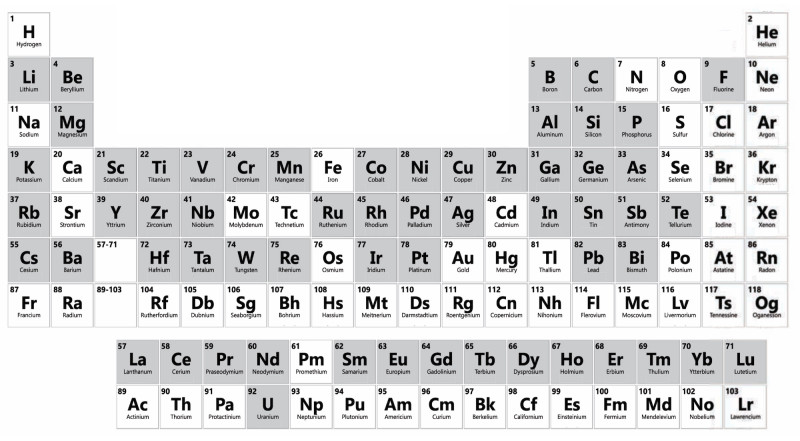
The US Critical Mineral List
Aluminum, Antimony, Arsenic, Barite, Beryllium, Bismuth, Boron, Cerium*, Cesium, Chromium, Cobalt, Copper, Dysprosium*, Erbium*, Europium*, Fluorspar, Gadolinium*, Gallium, Germanium, Graphite, Hafnium, Holmium*, Indium, Iridium, Lanthanum*, Lead, Lithium, Lutetium*, Magnesium, Manganese, Metallurgical coal, Neodymium*, Nickel, Niobium, Palladium, Phosphate, Platinum, Potash, Praseodymium*, Rhenium, Rhodium, Rubidium, Ruthenium, Samarium*, Scandium*, Silicon, Silver, Tantalum, Tellurium, Terbium*, Thulium*, Tin, Titanium, Tungsten, Uranium, Vanadium, Ytterbium*, Yttrium*, Zinc, Zirconium
*16 of the 60 minerals on the list are rare earths, which are chemically related, and often mined together. They are primarily used in specialty metals, electronics, and magnetics.
Aluminum (atomic number 13)
Aluminum is one of the most familiar and widely used metals on the Critical Minerals list. It is most commonly alloyed with other minerals to become a lightweight durable metal used in familiar products, from jets to soda cans. The US consumes more than six million metric tons of aluminum metal annually (out of a global total exceeding 60 million metric tons). Aluminum is on the critical materials list because of its use in important defense products, such as aircraft, and because little of it is mined or smelted domestically.
New aluminum (also known as primary aluminum) is made from bauxite ore. During World War II and soon after, the US led the world in aluminum production, and a few dozen massive aluminum metal smelters and mills could be found along major rivers across the country. Today there are only four primary aluminum smelters still functioning in the US: Alcoa’s smelters in Massena, New York, and Newburgh, Indiana, and Century Aluminum’s smelters in Mount Holly, South Carolina, and Sebree, Kentucky. Primary aluminum is used for specialty aluminum products, like aircraft and aerospace, and defense products, and makes up less than 20% of the aluminum consumed in the US. Most of it is imported in metal form from smelters in Canada. The three largest producers of bauxite ore are Guinea, Australia, and China. A very small amount of bauxite is still mined in Arkansas, around the town of Bauxite, once an important domestic source of the material.
Aluminum is highly recyclable, and more than 80% of aluminum metal consumed in the US is from recycled material (known as secondary aluminum). This is the aluminum that is used in packaging, wiring, construction, and consumer products. Nearly half of the scrap produced in the US is exported, while most of the aluminum consumed in the US is imported, in the form of processed secondary scrap.
Antimony (51)
Antimony has widespread commercial uses, including ceramics, as a fire retardant in car seats and mattresses, and blended with lead to reduce corrosion in lead-acid batteries in vehicles. In a highly refined form antimony is used in semiconductor chips and infrared devices. Antimony is also paired with beryllium for use as a startup material in nuclear reactors. Antimony’s military applications include its use as a combustion ingredient in detonators, smoke generators, and tracer bullets. It is also used to spark safety matches, and to provide glitter effects in fireworks.
China produces more than half of the world’s antimony, followed by Russia and Tajikistan. The US stopped mining antimony in the 1980s. The nation’s only antimony smelter, in Thompson Falls, Montana, processes imported material. A proposed mine is being developed in Idaho, located in a silver mining district where antimony was produced as byproduct. Approximately 15% of the 25,000 metric tons of antimony consumed in the US is recycled from, and then reused in, lead acid batteries.
Arsenic (33)
Arsenic is mostly used to preserve wooden railroad ties and light poles, and as an herbicide and insecticide. Arsenic also hardens lead in batteries and bullets. In a highly refined metallic form, arsenic is combined with other minerals, such as gallium, indium, and germanium in the production of semiconductors, solar cells, and infrared sensors in the fields of optics, telecommunications, and advanced electronics.
Arsenic is generally derived from gold, copper, and lead smelting, and domestic production officially stopped in 1985, when the ASARCO smelter in Tacoma, Washington, closed due to pollution problems. In recent years 95% of the arsenic metal used in the US has been imported from China. Arsenic also comes to the US from a hydro-metallurgical plant in Morocco. The US consumes around 8,000 metric tons annually.
Barite (56)
90% of barite’s domestic use is by the oil and gas industry, as drilling mud, essential to lubricate and stabilize oil and gas wells. It is also used in brake pads and paint primer. Barite blocks X-rays and gamma rays, making it useful as a radiation shield in nuclear power plants. Its refined elemental form, barium, is used as an additive in high-tech ceramics and optics.
Northern Nevada continues to be the nation’s largest domestic source of barite, where it is unearthed from open pits at four mines, each owned by one of the Houston-based global oil well services companies: Halliburton, Baker Hughes, Schlumberger, and NOV. Still, most of the barite used in the US comes from China and India.
Beryllium (4)
Beryllium is a commodity that can be refined into lightweight and strong metals that withstand heavy vibrations and high temperatures, properties that are highly prized in aerospace and defense applications. Beryllium is used in ceramics and electronics for missile guidance systems, radar, cell phone transmission, MRI machines, and nuclear weapons. Beryllium is also a critical component in nuclear reactor fuel and space-based mirrors and other optics.
One mine, in the Spor Mountains of western Utah, is the only domestic source of beryllium, and one of just a few sources of beryllium in the world. The company that extracts and processes the material, known for most of its existence as Brush Wellman, now called Materion, is still the only major US supplier of beryllium and its products, based out of a plant near the mine in Utah, and a larger engineering facility in Ohio. Around 200 metric tons are consumed in the US annually, though this amount fluctuates dramatically.
Bismuth (83)
Bismuth is a material and an element that is used in metallurgy, especially the manufacture of solder, bullets, and other items, as a less toxic form of lead (a similarly dense and heavy metal with a low melting temperature). Bismuth is used as the triggering material in fire sprinkler systems, in transistors and superconductors, and in pharmaceuticals (it is used to coat the stomach in products like Pepto-Bismol).
Bismuth is not directly mined. It is produced primarily from lead mining and refining, which once occurred all over the US, but which has decreased dramatically, starting in the 1980s, due to health and environmental legislation, and cheaper imported sources. Domestic production of bismuth finally stopped in 1997, with the closure of the ASARCO lead smelter in Omaha, Nebraska. The US recovers some bismuth from recycling, but imports most of its supply, around 2,500 metric tons annually, from China, Mexico, and other countries.
Boron (5)
Borax and other borates that contain boron have been used in ceramics and metallurgy for millennia. In modern times, borates have found their way into many commercial and industrial products, including bleaches, pesticides, fertilizers, wood preservatives, fire suppression, specialty glass (like Pyrex), rocket engines, and nuclear reactor control rods. Borates are a major component in fiberglass, including insulation and composites, and are combined with rare earths like neodymium to make super-strong magnets for generators, actuators, batteries, and tiny motors, such as those in computer hard drives. It is used as a dopant in semiconductor production, for LCD screen manufacturing, and for many components in cell phones.
As an element, boron is not generally found on its own, but rather in borate minerals and ores that accumulate in the beds of certain ancient pluvial lakes, including the bottom of Death Valley. More than half of the world’s supply comes from open-pit mines in Turkey, operated by the Turkish government. Most of the rest comes from the US Borax mine located in the Mojave Desert town of Boron, California. Owned by the international mining company Rio Tinto, the Boron operation is California’s largest open-pit mine, and ships around a million metric tons of product annually, including dried boric acid, all over the world.
Another major source of borates in the US is Searles Lake, 60 miles north of Boron, where a number of companies have been using a network of wells to extract and process potash and borates from a dry lakebed for more than a century. Also in the Mojave, near the town of Newberry Springs, a borate solution mine opened in 2024, operated by an Australian company called 5E Advanced Materials. In November 2025, the federal government added boron to its updated official list of 60 critical minerals.
Cerium (58)
Cerium is used in catalytic converters, ceramics, glass, metallurgy, and polishing compounds. It is used to control the colors in cathode ray TV tubes, LEDs, plasma screens, fiber optics, and lasers. Cerium is alloyed with aluminum to increase its temperature range in automotive parts, and alloyed with plutonium to make nuclear fuels.
Cerium is one of 16 rare earth elements that are on the critical minerals list, a group of minerals that are related to one another, and often extracted together, then processed separately. Rare earths are increasingly important to the production of batteries, and permanent magnets used in electrical generators, tiny electric motors, and actuators, as well as in other electronic devices and high-tech materials.
Cerium is among the rare earths that have been produced at the Mountain Pass mine in California, currently the only active rare earth mine in the US. The Mountain Pass mine opened in the 1950s, and quickly became the largest rare earth mine in the world. It was closed in 2002, due to environmental issues, and the fact that larger outputs from Chinese mines were making US production and processing too expensive to continue. The mine reopened in 2018, under new ownership (MP Materials Corporation), and with heavy support from the federal government. Efforts to open other domestic rare earth mines are also underway, in West Texas, Nebraska, Wyoming, Alaska, and a few other places.
Cesium (55)
Cesium metal is liquid at room temperature, and its uniquely high electropositivity and reactivity make it useful in research and development in chemistry and electronics. In various compounds, cesium is used in infrared detectors, optics, spectrophotometers, scintillators, and fluoroscopy. Isotopes of cesium are used for atomic clocks that control global time calibration and GPS satellites, and for food sterilization. Cesium formate is used in drilling fluids for oil and gas extraction.
Small amounts of cesium are involved in most of its applications. It is estimated that the US consumes around five metric tons of cesium annually, none of which is mined or processed domestically. Cesium is extracted primarily from pollucite ore, which for US consumption used to be sourced from the Bernic Lake Mine, in Manitoba, Canada, the world’s largest producer of cesium, and one of only two cesium mines. Also known as the Tanco Mine, it was operated for years by the US-based Cabot Corporation, which shipped the cesium, tantalum, and rubidium produced there to its processing sites in the US and Japan. Since 2019, the Bernic Lake mine has been owned by Sinomine Resources, a Chinese company, which processes the cesium in China, and does not currently report how much cesium is shipped to the US.
Chromium (24)
More than 600,000 metric tons of chromium is consumed annually in the US, nearly all of it to make stainless steel. Chromium is produced from chromite ore, which is mixed with iron and processed into ferrochromium to make stainless steel. Chromium is used to make other important metal alloys too. Chromium is also used in nuclear, solar, geothermal, and wind energy production.
Though there has been some chromite ore extraction domestically, notably in the Stillwater Mountains of Montana, the US is dependent on foreign sources for nearly all of this material that it uses. The largest mine is in South Africa, though there are others in India, Zimbabwe, Turkey, Kazakhstan, and Finland. Recycled scrap stainless steel is also a source of chromium, providing around 15% of domestic demand.
Cobalt (27)
Cobalt is perhaps best known for its importance in the rechargeable lithium-ion batteries used in cars, computers, and electronics of all kinds. It is also important as a superalloy in jet engines, as well as for its uses in missile guidance systems, sensors, radar, and machine tools.
The US has produced small amounts of cobalt in the past, from mines where cobalt was extracted as a byproduct of other types of mining, including in the copper-nickel belt in northeastern Minnesota. Currently, the nation’s only primary cobalt mine opened in 2022 in Idaho, but closed within months, due to plummeting prices from global suppliers. The mine is located next to a former cobalt mine that closed in the 1980s and became a Superfund site. Though around 70% of the world’s supply of raw cobalt comes from mines in the Congo, most of the 8,000 or so metric tons used in the US comes in refined and metallic form from Norway, Canada, Japan, Madagascar, and other countries.
Copper (29)
Copper is a familiar metal used in electrical systems, including in wiring and electronic products. It is also used in pipes, metallurgy, roofing, and many other applications. Approximately 1.1 million tons are produced annually in the USA, which accounts for most of the 1.6 million tons that are consumed domestically. 17 mines in the country account for 99% of this, with around 70% from mines in Arizona. Freeport-McMoRan is the largest US copper producer, with seven mines and one of the country’s two active primary smelters, in Miami, Arizona. The other primary smelter is in Utah, connected to the Bingham Canyon Mine, owned by Rio Tinto, which is the largest man-made hole on earth, by some ways of measuring.
Recycling existing copper provides around 35% of domestic supply. There are a few large secondary copper smelters and refineries processing this material, located in Texas, Georgia, South Carolina, Kentucky, and other states. Copper was added to the critical minerals list in November 2025, despite the apparent abundance of it in the US.
Dysprosium (66)
Dysprosium is one of 16 rare earth elements that are on the critical minerals list. A quality shared by several elements in this group is tremendous magnetic strength, which makes them in high demand for motors, generators, speakers, microphones, and many other applications. Dysprosium is one of the most powerful of them all. It is used to enhance the efficacy of neodymium-iron-boron magnets, which are currently the most desired form of “permanent magnets,” used in electric vehicle motors, wind turbines, micro-motors, and actuators. Dysprosium is also used in lasers, SONAR, metal-halide lamps, nuclear reactor control rods, and dosimeters.
China currently produces most of the world’s rare earth elements. The only domestic source for them is the Mountain Pass mine in California. Mountain Pass is currently focusing primarily on a group of light rare earth elements (especially neodymium and samarium). Dysprosium is a heavy rare earth element, which are less prevalent, and harder to extract and refine. Efforts to open more domestic rare earth mines are underway, in West Texas, Nebraska, Wyoming, Alaska, and a few other places.
Erbium (68)
Erbium, like dysprosium, is one of 16 rare earth elements that are on the critical minerals list, which are in high demand especially for their use in permanent magnets used in motors, generators, actuators, batteries, EVs, and defense aviation and electronics. Like some other rare earths, erbium is also used in fiber optics, optical amplifiers, lasers, glass colorants, and as a neutron absorber in nuclear reactor control rods.
Erbium is one of the heavy rare earth elements, which means it is more expensive to extract and refine. Reserves exist at Mountain Pass, the only rare earth mine in the USA. Efforts to open more domestic rare earth mines are underway, but for the foreseeable future, China remains the main source of erbium.
Europium (63)
Europium is the softest, least dense, and most chemically reactive of the rare earth elements, and one of the rarest. In the 1960s europium provided the bright red phosphor that made color television’s images colorful enough to become popular, which brought on a boom at the Mountain Pass mine, at the time the only viable source of europium. It’s phosphorescent qualities are still used for color in CRTs, LEDs and other illuminated displays. Like other rare earth elements it is also used in a variety of high-tech, energy, and defense applications, including nuclear reactor control rods.
Europium is one of the medium and heavy rare earth elements on the critical minerals list (along with dysprosium, erbium, gadolinium, holmium, lutetium, terbium, thulium, ytterbium, and yttrium). Currently the Mountain Pass Mine, the only rare earth mine in the USA, is focusing on the extraction and processing of light rare earths (lanthanum, cerium, praseodymium, neodymium, promethium, and samarium), but heavy rare earth mining also occurs there. Primary sources are China, Australia, and Russia.
Fluorspar (9)
Fluorspar is a mineral containing the element fluorine. The US consumes around 500,000 metric tons of the material a year, much of it in the form of hydrofluoric acid, which is used to make a host of fluorine-related chemicals used in refrigerants, lithium-ion batteries, glass, welding products, castings for steel and iron, cement production, gasoline, and as a key ingredient in the processing of aluminum and uranium. Fluorine is important in some PTFE coatings, like Teflon, and in the fluoridation of public water supplies.
The US was the leading producer of fluorspar until the mid-1950s, mining from regions that included Illinois, Kentucky, and Utah. Foreign competition drove down prices, and by 1982, there was just one company in the US left, which closed its mine in 1996. Recent attempts to start domestic fluorspar mining include the Lost Sheep Mine, located in a former fluorspar district in the Spor Mountains of Utah (also the nation’s primary source of beryllium). China is by far the largest producer, accounting for at least 70% of the world’s production, followed by Mexico, and Mongolia.
Gadolinium (64)
Gadolinium is used in metallurgy to prohibit oxidation in steel. It’s magnetism is used to make permanent magnets, and as a contrasting agent in magnetic resonance imaging (MRI). It’s phosphorescent properties are used in TVs, LEDs, fiber optics, and lasers. Like some other rare earths, gadolinium is also a neutron absorber used in naval nuclear reactors.
Gadolinium is one of the heavy rare earth elements on the critical minerals list. Currently the Mountain Pass Mine, the only rare earth mine in the US, is focusing primarily on the extraction and processing of light rare earths, which are more abundant there, and easier to process. Sources for heavy rare earths like gadolinium are mostly in China, though rare earth mines also exist in Australia, India, and Brazil, and more are being explored.
Gallium (31)
US industry consumes only around 20 metric tons of gallium annually, but it is essential to many high-speed integrated circuits related to communications, including cell phones and high-voltage RF systems such as radar, and in optoelectronics. Gallium does not exist in mineable quantities by itself, and is usually extracted from bauxite and zinc ores.
Gallium has not been produced in the US since 1987, and now China accounts for most of its global production. A domestic mining operation focusing on gallium and rare earths has been proposed for a site in southwestern Montana.
Germanium (32)
Germanium is used in military optics, especially night vision and infrared applications, and in the production of solar cells.
A large zinc mine in Alaska ships ore to a processing facility in Canada that produces some germanium. Germanium and gallium are sometimes extracted at the same time from zinc processing, and the nation’s only zinc smelter, located in Clarksville, Tennessee, may begin producing germanium soon. Germanium is also recovered from recycled military optics, including tank windows. China dominates global production of germanium.
Graphite (6)
Graphite is a crystalline form of carbon, used in brake linings, lubrication, steelmaking, fuel cells, and, increasingly, lithium-ion batteries.
No graphite is mined in the US, but the government has recently supported the development of a number of domestic graphite mining operations, and assessments are underway in Alabama, Alaska, Montana, and New York. A graphite processing facility for an Alaskan mine is planned for the former defense stockpile site in Warren, Ohio. China produces around 75% of the world’s graphite.
Hafnium (72)
Hafnium is used in nuclear control rods, and hard metals alloys used in high-temperature applications like jet engines and gas turbines. Hafnium is closely aligned to zirconium, another critical mineral. Both are produced from heavy mineral sands.
A small amount of the hafnium used in the US is produced from surface mines in Florida and Georgia, but most of it comes from mines in Australia, South Africa, and other African nations. Processing is also performed in Russia, Germany and France.
Holmium (67)
Holmium, a rare earth, has the highest magnetic permeability and saturation of all the elements. This manifests in a strong magnetic field, and an ability to make metal magnets more powerful. Like other rare earths, holmium strongly absorbs neutrons, which make it useful in controlling nuclear reactors. Also, like other rare earths, holmium is used in lasers, fiber optics, permanent magnets, and glass coloring.
Holmium is one of the heavy rare earth elements on the critical minerals list. Currently the Mountain Pass Mine, the only rare earth mine in the US, is focusing primarily on the extraction and processing of light rare earths, which are more abundant there, and easier to process. Sources for heavy rare earths like holmium are mostly in China, though rare earth mines also exist in Australia, India, and Brazil, and more are being explored, including domestically in West Texas, Nebraska, Wyoming, and Alaska.
Indium (49)
Once used in aircraft engine bearings, indium has the effect of increasing the speed in some fiber optic telecommunication networks, where it is used in lasers and coatings. Indium is also used to increase speed in semiconductors, and in liquid crystal displays. Around 150 metric tons are consumed annually in the US.
Indium is extracted from zinc sulfide ores, and a zinc-copper-silver-indium mine in Utah’s West Desert is under development. Otherwise, much of the domestic consumption of the material is recycled from scrapped LCD monitors, and imported from Korea and Japan. China is the largest global producer of the material.
Iridium (77)
Highly resistant to corrosion, iridium is used as a coating on anodes for electrochemical processes, as a metal in spark plug electrodes, in semiconductors, and in some types of flat-screen displays. It is also used in guided missile systems, aircraft engines, and radar screens. Less than three metric tons are consumed annually in the US.
Small amounts of iridium are extracted with other materials at a few mines in the US, including one in the Stillwater region in Montana, operated by a South African company. Iridium is one of the six closely aligned materials in the platinum metal group, which include the critical minerals palladium, platinum, rhodium, and ruthenium. Platinum group metals (PGMs) are generally mined together, then separated by processing the ore. The leading global producer is South Africa, followed by Canada and Russia.
Lanthanum (57)
Lanthanum is used to produce catalysts, ceramics, glass, polishing compounds, metallurgy, and batteries. Nickel-metal hydride batteries of the type used in some hybrid vehicles contain more than 30 pounds of lanthanum. It is also used in lighter flints, tungsten welding rods, phosphor and carbon lamps, and fiber optic cables.
Lanthanum is one of six light rare earth elements on the critical minerals list (along with cerium, praseodymium, neodymium, promethium, and samarium). Currently the Mountain Pass Mine, the only rare earth mine in the US, is focusing on the extraction and processing of neodymium and praseodymium for use in permanent magnets. China produces most of the world’s lanthanum, though rare earth mines also exist in Australia, India, and Brazil, and more are being explored.
Lead (82)
Lead is a soft, dense, and heavy metal, used primarily in lead-acid batteries, which consume as much as 85% of the lead produced and imported in the US. The remaining 15% is used to make ammunition (3%), glass, ceramics, solder, and in many other things. The US was the largest producer of lead in the world until the 1980s, when environmental regulations began to have an effect on the industry. Today the US is ranked third, producing around 300,000 metric tons annually, behind Australia (430,000 metric tons) and China, which produces almost two million metric tons annually. All of the lead mined in the US has to be exported to be refined, as the last primary lead refinery in the nation was shut down in 2013. This is one of the reasons why lead was added to the critical minerals list in 2025.
Most of the lead mined in the US comes from five underground mines, located in the Viburnum Trend mining district in southeastern Missouri, operated by the Doe Run Company, which has dominated lead production in the US for more than 100 years. Doe Run is owned by the Renco Group, which also owns a large magnesium plant in Utah, which was originally a lead plant. Lead is also produced as a byproduct from four other domestic mines: two zinc mines in Alaska, and two silver mines in Idaho.
Lead is one of the most recyclable of metals, and more than 70% of the lead consumed in the US is from secondary, recycled sources, more than one million metric tons annually. Doe Run operates the largest lead recycling center in the country at one of its mine sites in Boss, Missouri, where more than eight million car batteries are reprocessed every year.
Lithium (3)
Lithium has uses in ceramics, medicine, and as an industrial lubricant, but close to 90% of it is used for lithium-ion batteries, which have rapidly emerged as the principal form of energy storage in industry, electronics, and electric vehicles.
Currently, the only source of lithium in the US is an evaporative surface mine in Silver Peak, Nevada. The mine has been producing lithium for decades, but only a very small fraction of the current national demand. The federal government recently supported more than 25 new lithium projects in the country, a few of which have broken ground. Australia currently mines the most lithium in the world, followed by Chile and China.
Lutetium (71)
Lutetium is used as a catalyst in petroleum cracking, in PET scanners and other medical imaging systems, and in scintillators that convert X-rays to visible light. It is also used to date meteorites.
Lutetium is one of the 16 rare earth elements that are on the critical minerals list, though it is especially difficult to isolate from the other rare earths, and global production is limited, usually less than 20 tons per year. China is the primary producer and processor of the material.
Magnesium (12)
Magnesium metal is principally alloyed with aluminum, creating a lightweight metal used in aviation, castings, and beverage containers. Magnesium is also used as an alloy to produce other hard lightweight metals of use in aerospace and defense applications.
For decades most primary magnesium production in the US was from a single mine and industrial plant in Utah, owned by US Magnesium. The mine extracted the material from Utah’s Great Salt Lake, concentrating brine through 75,000 acres of evaporation ponds. Due to competition and advances in production and processing by Chinese suppliers, and increasing local environmental costs, the plant ceased production in 2022. The mine also extracted lithium from the brine, but stopped doing so in 2024. A related titanium plant at the site closed in 2016. Other magnesium sources in the US are being developed in Nevada and Wyoming. But currently no magnesium metal is being produced from scratch in the US.
Manganese (25)
Manganese is mostly consumed by the steel industry, as an important component in pig iron. In another form, manganese dioxide and sulphate is used in batteries, including the in-demand lithium-ion type. More than 700,000 metric tons of it is used annually in the US.
The US has not produced manganese since the 1970s, but due to its criticality, the US Defense and Energy departments have supported the accelerated opening of a mine and battery-grade production facility in Arizona, owned by an Australian company. South Africa produces most of the manganese ore consumed in the world, followed by Gabon and Australia. Processed manganese comes from Malaysia, Australia, and Norway.
Metallurgical Coal (6)
Metallurgical coal is used to make coke, a form of reactive carbon used in blast furnaces to make primary steel. It takes around three quarters of a ton of coal, turned into coke, to make a ton of steel, and the US steel industry uses more than 15,000,000 metric tons of this coal per year. Most of the major steel plants operate a nearby coke plant to feed into their furnaces. A third of the steel produced in the US is primary steel, requiring coke. The rest, two thirds, is made from recycled scrap steel.
The coal used for coke-making is different from most of the thermal coal used to boil water, to make steam, to make electricity in large power plants, which is what more than 90% of the coal consumed in the US is for. Metallurgical coal tends to come from eastern coal mines, not from the bigger western mines, which have higher ash and moisture content. West Virginia supplies as much as 40% of the metallurgical coal in the US. Metallurgical coal was added to the critical minerals list in November, 2025, despite the fact that around 75% of the metallurgical coal mined in the US is exported. The US is the second largest exporter of it in the world.
Neodymium (60)
Neodymium is one of the better-known rare earths, and is more abundant and commonly used than most. Neodymium is in lasers, glass, LCDs, and lighting, but its primary use is in magnets, found in microphones, speakers, headphones, small electric motors, like in hard drives, toys, and car seats, and in larger electric motors, used in electric cars, as well as in generators and wind turbines. Neodymium-iron-boron magnets are the strongest known magnets in the world, at ambient temperatures, and the most common form of permanent magnets. A wind turbine has a few tons of them.
Neodymium is one of the 16 rare earth elements that are on the critical minerals list, and is the primary mineral currently extracted at the Mountain Pass mine in California, the only major rare earth mine in the USA. Efforts to open other domestic rare earth mines are underway, in West Texas, Nebraska, Wyoming, Alaska, and a few other places. Globally, China currently controls at least 60% of rare earth mining, and 90% of rare earth processing.
Nickel (28)
Most nickel in the US is used to make stainless steel. Some is also used to make other corrosion-resistant superalloys. The aerospace industry is a major consumer of these nickel-based superalloys, used for things like jet engines. Nickel is also used in batteries. Around 200,000 metric tons is consumed in the US annually, around half of which is recycled from scrap.
The only domestic nickel mine, the Eagle Mine in Michigan, produces 17,000 metric tons a year, a fraction of what is consumed nationally, and its concentrated ore is shipped to Canada to be smelted. The Defense Department has recently supported a nascent nickel production project in Missouri. Indonesia dominates the global supply of mined nickel, though the US imports a considerable amount from Canada too.
Niobium (41)
Niobium is a hard metal, like titanium. Around 75% of niobium that is consumed in the US is used as an alloy in steel. 20% of it is used to make non-ferrous superalloys, favored by aerospace industries.
US mines stopped producing niobium in the 1950s. Today nearly all of it is mined in Brazil, although a company is in the early stages of developing the Elk Creek Project, a new niobium mine in southeast Nebraska, and the Department of Defense is helping to expand a plant in Boyertown, Pennsylvania, that produces tantalum (another critical mineral with similar properties) into one with niobium production capabilities as well.
Palladium (46)
Palladium is used in a variety of medical, metallurgical, and chemical applications, but most of it is consumed as a component in automotive catalytic converters, which remove pollutants coming out of the tailpipes of internal combustion engines.
Palladium is one of six closely aligned materials in the platinum metal group, which include the critical minerals platinum and rhodium. A South African company operates the only platinum group mines and processing facility in the US, located in the Stillwater region in Montana, which produces around eight metric tons annually. Around 70 metric tons are consumed annually in the US. Platinum group metals (PGMs) are generally mined together, then separated by processing the ore. The leading global producer is South Africa, followed by Russia and Canada.
Phosphate (15)
Phosphates are mineral compounds that contain phosphorous, an element that is essential to root growth and other plant functions. Phosphorous is one of the three primary nutrients used in agriculture (along with nitrogen and potassium), and is extracted from concentrated deposits of phosphate rock in large quantities, processed and distributed globally to supply industrial agriculture. The United States was the world’s largest producer of phosphate rock from the end of the 19th century until 2006, when US production was exceeded by China. Today the US is the third largest global producer of phosphates. Most of it comes from a region east of Tampa, Florida called the Bone Valley, where all of the mines are now owned and operated by the Mosaic Company.
Mosaic was formed in 2004 by merging Cargill’s crop nutrition division and IMC Global, and the merger instantly created the largest US-based producer of phosphate fertilizer, and potash. Mosaic is not the only company mining and processing phosphates in the US on a large scale. Nutrien operates the largest integrated phosphate mining and chemical plant in the nation, in Aurora, North Carolina. Idaho has major phosphate operations too, run by Itafos, Bayer/Monsanto, and Simplot, which also operates in Wyoming and Utah. Together, ten domestic phosphate operations generate more than 20 million metric tons of the product annually, slightly less than what the nation consumes. An additional three million metric tons or so is imported, usually from Peru or Morocco, the second largest global producer of phosphates, after China.
Phosphates have other uses, including in metallurgy, pharmaceuticals, lithium-iron-phosphate batteries, safety matches, and semiconductor manufacturing. It was added to the critical minerals list in November, 2025, along with potash, another material vital to industrial agriculture.
Platinum (78)
Platinum is a rare and precious metal of high value. It is the least reactive of all metals, meaning it does not easily corrode, even in extremely high temperatures. Platinum is used in a variety of medical, metallurgical, and chemical applications, including in aircraft turbines and LCD displays, but most of it is consumed as a component in automotive catalytic converters.
Platinum is one of six closely aligned materials in the platinum metal group, which include the critical minerals palladium, rhodium, iridium, and ruthenium. Platinum group metals (PGMs) are generally mined together, then separated by processing the ore. A South African company, Sibanye-Stillwater, operates the only US platinum group mines in the nation. The company’s smelter and refinery, in Columbus, Montana, also recycles palladium and platinum from scrapped catalytic converters. Around 170 metric tons of platinum is produced annually, globally, not including secondary/recycled sources, and the US consumes around 70 metric tons. The Stillwater mine produces around two metric tons. The leading global producer of PGMs is South Africa, followed by Russia and Canada.
Potash (19)
Potash is a water-soluble mineral containing potassium. Potassium is vital to plant growth, and the mining and processing of potash is the primary source of potassium for large-scale industrial agriculture. Potassium is also used in chemicals, pharmaceuticals, soap, glass, batteries and other products, including, importantly, potassium nitrate, used to make gunpowder and explosives.
The potash industry expanded in the US in World War I, when prices and demand for it went up because Germany controlled much of the global supply at that time. Mineral rich dry lake beds in the southwest, like California’s Searles Lake, ramped up production, starting in 1914. Industrial agriculture expanded after the war, with the integration of the Haber-Bosch process to use natural gas to create fixed nitrogen, further industrializing the supply of potash (and phosphates) for fertilizer.
Large amounts of potash were discovered in southeast New Mexico in the 1930s, and the area became the center of the potash industry in the US, producing more than three quarters of the potash mined in the US. Though reduced, more than half of domestic production still comes from here, from three mining operations, one owned by Mosaic, which is the nation’s largest phosphate producer too, and the other two by Intrepid Potash, based in Denver. Intrepid also has two potash mines in Utah, and is the only US company dedicated solely to producing potash in the USA.
US companies operating in southeast New Mexico developed potash mines in Saskatchewan, Canada, which are now the largest producers in the world. More than 40 million metric tons of potash is mined globally, annually, and the Saskatchewan mines (the largest of which is owned by Mosaic), produce around a third of it. Other large producers are Belarus, Russia, and China. The US produces only half a million tons, and is dependent on imports, primarily from Canada, for more than 90% of its needs. Potash was added to the critical minerals list in November, 2025, along with phosphate.
Praseodymium (59)
Praseodymium is one of 16 rare earth elements that are on the critical minerals list. Unique industrial uses of it often relate to it’s ability to filter yellow light. It is found in some types of goggles used in welding and glassblowing, and is alloyed with magnesium to make aircraft engine components. Otherwise it is used with other rare earths and minerals in magnets, batteries, ceramics, and colorants.
Praseodymium is one of six light rare earth elements (along with cerium, lanthanum, neodymium, promethium, and samarium). The Mountain Pass Mine, in California, the only major rare earth mine in the US, is focusing on the extraction and processing of light rare earths, primarily neodymium and praseodymium for use in permanent magnets. China produces and processes most of the world’s praseodymium, though rare earth mines also exist in Australia, India, and Brazil.
Rhenium (75)
Rhenium is one of the rarest elements found on the earth. It has a very high melting point, and around 80% of it is combined with other metals, including nickel, to make superalloys for high-temperature applications, like jet engine turbines. General Electric, Rolls Royce, and Pratt & Whitney consume around two thirds of the world’s rhenium. It is also used to make crucibles, electrical contacts, electromagnets, heating elements, mass spectrographs, thermocouplers, and as a catalyst to make high octane fuels.
Most rhenium is extracted from molybdenum processing, which occurs in some large-scale copper mines and refineries. The Continental Mine, in Butte, Montana, and Freeport-McMoRan’s Sierrita mine in Arizona are a source. Rio Tinto’s Bingham Canyon copper mine and refinery in Utah is also a source, though in recent years it has shipped its rhenium-containing molybdenite concentrates to Mexico to be processed, and from there to Chile for purification.
Rhenium was added to the critical minerals list in November 2025. Though the US is one of the largest producers of rhenium, generating around 10 tons a year, this is less than half of what it consumes. Annual global production is around 60 tons, half of which comes from Chile, home of the largest copper mine in the world. Around 30% of rhenium is recovered from recycling.
Rhodium (45)
Rhodium is one of six platinum group metals. It is used mostly as an alloy with platinum and palladium, the more commonly found metals of the platinum group, in the fabrication of automotive catalytic converters. Small amounts are also used in neutron flux detectors in nuclear reactors.
Rhodium is considered very rare, and only around 30 metric tons of it are produced annually, globally. The only US platinum group mines and processing facilities in the nation are located in the Stillwater region of the Beartooth Mountains in Montana, which may produce a small amount of it. Some amount is recovered from scrap catalytic converters too. The leading global producer is South Africa, followed by Russia and Canada.
Rubidium (37)
Rubidium is a highly reactive alkali metal that reacts explosively with water. Rubidium is used in research test equipment, and in optoelectronics, night vision gear, and quantum computing. It is used as an oscillator for telecommunications synchronization, including cell networks and global positioning systems. Rubidium also provides the purple color in some fireworks. Rubidium is extracted mostly as a byproduct of cesium and lithium mining, and is consumed in very small quantities. As little as one or two metric tons are produced annually, globally.
Rubidium is not mined or processed domestically. In the past, the US-based Cabot Corporation produced it at its cesium mine in Bernic Lake, Manitoba, Canada, and processed it at its supermetals plant in Boyertown, Pennsylvania. However both facilities have been sold. Since 2019, the Bernic Lake mine has been owned by Sinomine Resources, a Chinese company which does not process rubidium in US. The Boyertown metals plant in Pennsylvania is now owned by Global Advance Metals, an Australian company that is focusing on tantalum and niobium processing at the site. China controls most of global rubidium production, though other sources are being considered, including on the remote Italian island of Elba.
Ruthenium (44)
Ruthenium is one of six platinum group metals (PGMs), and like the others is durable and non-reactive. Ruthenium is consumed in small amounts, primarily in electrical contacts and in thick film chip resistors, microcircuitry of the type used in electric vehicles.
A small amount of ruthenium is extracted from the Stillwater and East Boulder platinum group metal (PGM) mines in Montana. Some is also extracted from Stillwater’s PGM recycling center in Columbus, Montana. Most of it comes from PGM mines in South Africa, and Russia’s Ural Mountains. Only around 40 metric tons of ruthenium are produced annually, globally.
Samarium (62)
Samarium is one of 16 rare earth elements that are on the critical minerals list. It is mostly used in samarium-cobalt magnets, which are favored in high-temperature environments (above 150°C), as neodymium-iron-boron magnets lose effectiveness at these high temperatures. Samarium-cobalt magnets are used in things like military aircraft and missiles. An F-35 fighter jet contains around 50 pounds of samarium-cobalt magnets.
Samarium is one of six light rare earth elements (along with cerium, lanthanum, neodymium, promethium, and praseodymium). The Mountain Pass Mine, in California, the only major rare earth mine in the USA, is focusing on the extraction and processing of some light rare earths, but primarily neodymium and praseodymium for use in permanent magnets. China produces and processes most of the world’s samarium.
Scandium (21)
Scandium is one of the lesser used rare earths, with fewer than 30 tons produced globally, annually (compared to more than 10,000 tons of neodymium, and 1,000 tons of samarium). Scandium’s primary use is as an alloy with aluminum to make aerospace components and sporting equipment, such as baseball bats and lacrosse sticks. It is also used in some handguns. Scandium is used in metal-halide lamps as well.
Scandium is one of 16 rare earth elements that are on the critical minerals list, some of which are produced in small amounts at the Mountain Pass mine in California, the only major rare earth mine in the US. However scandium is not one of them. Most scandium is sourced and processed in China.
Silicon (14)
Silicon was added to the critical minerals list in November, 2025. While it is among the most prevalent elements on the planet (more than 90% of the earth’s crust is made of silicates), and one of the most mined minerals (silica sand, from pits and dredging, is used to make concrete, ceramics and glass), sources of silica pure enough for making into feedstocks for electronics and metallurgy are less abundant. Primarily though, it is the relative lack of large-scale processing of highly refined silicon in the US, given the high demand for it, that makes it more of a critical material (semiconductors can require silicon that is refined to 99.9999999% pure elemental silicon). The supply of processed high-grade silicon for US computer and solar panel companies is mostly from Japan, Germany, South Korea, and China.
Around half of the silicon that is turned into metal is processed into ferrosilicon, which is used to make alloys of steel, and other iron-based metals. A more purified type of silicon is used to make other silicon metals, including monocrystalline silicon and polysilicon for semiconductors and solar panels, and as feedstock for chemical companies to make into all kinds of things. Companies that produce ferrosilicon and silicon metal in the US include Mississippi Silicon, which produces around 10% of the domestic supply at a new plant in Mississippi.
Only a few companies produce high purity silicon for semiconductors and solar panels in the US. Among them is Sibelco, a Belgian silica company with mines and plants in Spruce Pine, North Carolina; Hemlock Semiconductor, in Michigan; and Wacker Chemie, a German company with a plant in Tennessee. Another, the REC plant in Moses Lake, Washington, is attempting to restart production after shutting down in 2019. The US produces around 310,000 metric tons of ferrosilicon and silicon metal a year, and imports more from Canada, Brazil, Norway, and other countries. China produces 7,400,000 metric tons (about 80% of global production).
Silver (47)
Silver is a highly conductive metal used in semiconductors, photovoltaics, electric vehicles, communications equipment, missile guidance systems, satellites, and more. Half of the silver consumed in the US, though, is turned into investment bars, commemorative coins and medals, silverware, and jewelry. Still, it was added to the critical minerals list in November, 2025, to stimulate domestic production, as most of the silver consumed in the US is imported.
The US produces 1,100 metric tons of silver a year, around 17% of the silver it consumes. This comes from a few sources, including the largest silver mine in the country, the Greens Creek mine, located on an island off the coast of Juneau, Alaska. There are three other active silver mines in the US: the Rochester mine in Nevada (a state once known as the Silver State for its infamous Comstock Lode) and two in the Coeur d’Alene region of Idaho.
A major source of silver is as a byproduct or co-product at more than 30 base metal mines in the US. Additionally there are more than 20 refineries which produce silver from imported ore (1,200 metric tons/year), and scrap (also 1,200 metric tons). Around 4,200 metric tons of silver is imported annually, around two-thirds of US consumption, much of it from Mexico, which is the largest producer of silver in the world.
Tantalum (73)
Tantalum is a dense, hard, lightweight and ductile metal with a high melting point, used in making superalloys for jet engine components, nuclear reactors, missiles, and armor-piercing ammunition. Tantalum is also used in electronics, especially capacitors and resistors capable of withstanding high temperatures, making it useful in test equipment, data centers, GPS, and missile systems.
Little to no tantalum is mined in the US. The development of a domestic source has been subsidized by the US government, and Round Top Mountain, a proposed rare earth mine in western Texas, is expected to be a source for tantalum. Tantalum is processed in the former Cabot Supermetals plant in Boyertown, Pennsylvania, acquired by Global Advanced Metals, of Australia, which imports tantalum from its Australian mines. Tantalum is similar to the critical mineral niobium, with which it is often mined, though in smaller quantities. Australia was the primary source of the material for decades; however, recent developments in the Congo, Rwanda, and Burundi have made Africa the main source. Around a thousand metric tons is consumed in the US annually.
Tellurium (52)
Tellurium is a brittle metalloid that is used in metal alloys, and as a semiconductor. Tellurium has thermal and photoconductive properties which make it useful in certain electronic applications, and in thin-membrane, non-silica photovoltaic panels, which is its main commercial use. Tellurium is also used as a vulcanizing agent for rubber, in blasting caps, and in computer memory chips.
Tellurium is one the rarest solid elements, and is not generally found in mineable quantities. It is primarily extracted as a byproduct of large-scale electrolytic copper refining, where it is recovered from the sludge that collects on anodes. This occurs in two places in the US: at ASARCO’s copper refinery in Amarillo, Texas, and at Rio Tinto/Kennecott’s Bingham copper pit and refinery in Utah. China produces most of the world’s tellurium.
Terbium (65)
Terbium is mostly used to create green phosphors in trichromatic (red/green/blue) lighting applications, in cathode ray tubes (TVs), LCD screens, and industrial and commercial lighting. Terbium is also used as a stabilizer in fuel cells, in magnetic actuators, fiber optics, and naval sonar systems.
Terbium is one of the 16 rare earth elements that are on the critical minerals list, most of which are produced in small amounts at the Mountain Pass mine in California, the only major rare earth mine in the US. Efforts to open other domestic rare earth mines are underway, in West Texas, Nebraska, Wyoming, Alaska, and a few other places. China currently produces around 95% of the world’s rare earth elements.
Thulium (69)
Thulium is the second scarcest rare earth element, after promethium. Thulium is used in solid-state lasers and as a radiation source in X-ray devices. It is also used in high-temperature superconductors and dosimeters.
Thulium is one of 16 rare earth elements that are on the critical minerals list, some of which are produced in small amounts at the Mountain Pass mine in California, the only major rare earth mine in the USA. Thulium is not currently known to be extracted from there, nor is it mined or processed anywhere else in the US. Less than 50 metric tons are produced annually, globally, primarily in China.
Tin (50)
Tin is a ubiquitous metal, used in many essential things. Much of the tin consumed is for electronics, especially as solder. The rest is used in metal alloys, chemistry, the tinning of steel cans for food containers, and a myriad of other uses, including as a component in superconducting magnets, nuclear fuel rod cladding, lithium-ion battery anodes, and liquid crystal displays.
No tin is currently mined or smelted domestically. The last US tin mine closed in 1993, and though large placer deposits in Alaska remain from the early 1900s, including at Tin City, on the tip of the Seward Peninsula, these reserves pale in comparison to global sources that are currently supplying the world, such as those in Peru, Bolivia, Indonesia, Brazil, western Africa, and China. More than 350,000 metric tons of tin is produced annually, globally. The US consumes around 40,000 metric tons, annually, as much as 25% of which is recycled from industrial scrap.
Titanium (22)
More than 95% of the titanium concentrates extracted from the various and relatively abundant ores that contain it are consumed in the form of titanium dioxide, a white pigment used in paints, paper, plastics, and toothpaste. 3% or less is used to make titanium sponge, the feedstock for the durable lightweight metal alloys that make it a critical mineral. Titanium alloyed with aluminum is used in many commercial and military aircraft frames. Titanium alloyed with other metals are in jet engines, Apple computers, tennis rackets, eyewear, and many other products.
The US has been a major source of titanium in the past, including from a large mine in the middle of New York’s Adirondack State Park, and from a magnesium extraction plant at Utah’s Great Salt Lake. Production facilities included the massive TIMET plant in Las Vegas, and the ATI titanium sponge plant in Albany, Oregon. While these facilities have closed, some domestic titanium mining occurs in the Trail Ridge area of Georgia and Florida, but it doesn’t supply the form of the mineral used in metallurgy. China dominates global titanium production, followed by Mozambique and South Africa.
Tungsten (74)
Tungsten is a hard metal principally coupled with carbide to make cutting tools for metalworking, construction, and mining. Tungsten wire is used in lighting filaments, X-ray tubes, electrodes, and welding. When alloyed with other heavy metals it is used in armaments, and penetrating projectiles, as well as in turbines and other machinery. Tungsten also is used in radiation screening, electron beams, and integrated circuits. Around 10,000 metric tons is consumed in the US annually, out of a global supply of around 80,000 metric tons.
The US has been a major producer of tungsten, historically, but it has not been mined domestically since 2015. Today its supply is dominated by China (more than 80% of global production), with some tungsten coming from Vietnam, Russia, Bolivia, Australia, and a few other countries. Some tungsten deposits in the US are in the early stages of being developed, and some mothballed mines may become active again.
Uranium (92)
Uranium was added to the critical minerals list in November 2025 (up to that point, fuels were outside the scope of the list). Its use is critical for powering nuclear reactors, those that power around 20% of the US electrical grid, but also for reactors that power all naval aircraft carriers and submarines. Uranium is also used in armor piercing bullets, and, of course, in nuclear weapons.
The US currently produces around 300 metric tons of uranium annually, around 1% of the uranium consumed in the nation’s nuclear reactors. This came from a few intermittently active mines, mostly in Wyoming. Most of them are “in situ” mines, meaning they extract uranium by flushing water through underground ore bodies, like Wyoming’s Lost Creek and Smith Ranch mines. The White Mesa Mill, in Utah, is the only remaining active conventional uranium mill in the nation. The US imports nearly all of the approximately 23,000 metric tons of uranium its commercial reactors consume, annually. Primary sources are Kazakhstan, Canada, Namibia, Australia, and Uzbekistan.
Vanadium (23)
Vanadium has been used to harden steel, since its first industrial use in the Model T. Vanadium is also used for alloys of aluminum and titanium, favored by defense industries for aircraft engines and structural components. Vanadium is used in utility-grade battery storage systems as well.
Mines in the southwest have produced small amounts of primary vanadium as a byproduct of uranium mining in recent years, and efforts are underway to produce more at projects proposed in Utah, Colorado, and Nevada. China is the largest global source of vanadium, producing around 70%, followed by South Africa and eastern Russia. Around 100,000 metric tons are produced annually, globally. The US consumes around 15,000 metric tons annually. Much of it is produced from secondary sources, extracted from steel smelter slag, ash, oil refining wastes, and other industrial processes, which generates as much as 8,000 tons a year in the US. A few hundred tons are produced from recycled metal sources in the US too. A few domestic companies specialize in processing it, such as U.S. Vanadium, in Arkansas.
Ytterbium (70)
Ytterbium is mainly used in stainless steel alloys, and in lasers. Ytterbium is also used as a gamma ray source. It is an unstable metal, which can spontaneously combust and explode at room temperatures, and is stored in sealed inert atmosphere containers. Its electrical resistance changes when subjected to high physical stress, which makes it useful in sensors that monitor ground deformations from earthquakes and explosions.
Ytterbium is one of 16 rare earth elements that are on the critical minerals list, some of which are produced in small amounts at the Mountain Pass mine in California, the only major rare earth mine in the USA. Ytterbium is not currently known to be extracted from there, nor is it mined or processed anywhere else in the US. Around 50 metric tons are produced annually, globally, primarily in China.
Yttrium (39)
Yttrium was originally highly prized for its contributions to the color red in the cathode ray tubes of early color televisions. Some of these properties are still of use in LED screens and lasers. Like some other rare earths, Yttrium is also used in aluminum and magnesium alloys, camera lens glass, superconductors, spark plug electrodes, and battery cathodes.
Yttrium is one of 16 rare earth elements that are on the critical minerals list, some of which are produced in small amounts at the Mountain Pass mine in California, the only rare earth mine in the USA. Though yttrium has been produced there historically, just about all of the 6,000 or so metric tons of yttrium produced annually is mined and processed in China.
Zinc (30)
Zinc is the fourth most consumed metal, measured by production tonnage, after iron, aluminum, and copper. Most of it is used to galvanize metal, limiting corrosion in iron and steel. Zinc is also used as an alloy to make bronze and brass, and is the primary metal in billions of US pennies. Zinc is used in smaller amounts in many industries and products, including rubber, agriculture, semiconductors, lasers, nuclear reactors, medicines, sunscreens, and dietary supplements.
Though the largest zinc mine in the world is in Alaska (the Red Dog Mine, which supplies around 10% of the world’s zinc ore), the US imports just about all the zinc it consumes (mainly from Canada, where the ore from the Red Dog Mine is shipped and refined). There is only one primary zinc refinery currently operating domestically, in Clarksville, Tennessee, where a few mines also produce a limited amount of zinc. China produces (and consumes) much of the rest of the world’s zinc ore, followed by Australia and Peru.
Zirconium (40)
Zirconium is used in high-temperature industrial applications, including ceramics, refractories, in foundry sands for metal castings, and in some critical hard metal alloys. It is used in cladding nuclear fuel, and is often sourced with a small amount of hafnium, another critical mineral to which it is closely aligned, which is also used in nuclear reactor control rods. Zirconium is used in flashbulbs, prosthetics, deodorants, space propulsion thrusters, and diamond-like cubic zirconia.
A small amount of Zirconium is produced from domestic surface mines in the heavy sands of the Trail Ridge district of northern Florida and southern Georgia, which also produce titanium. Most of the zirconium used in the US comes from zircon mines in Australia and South Africa.